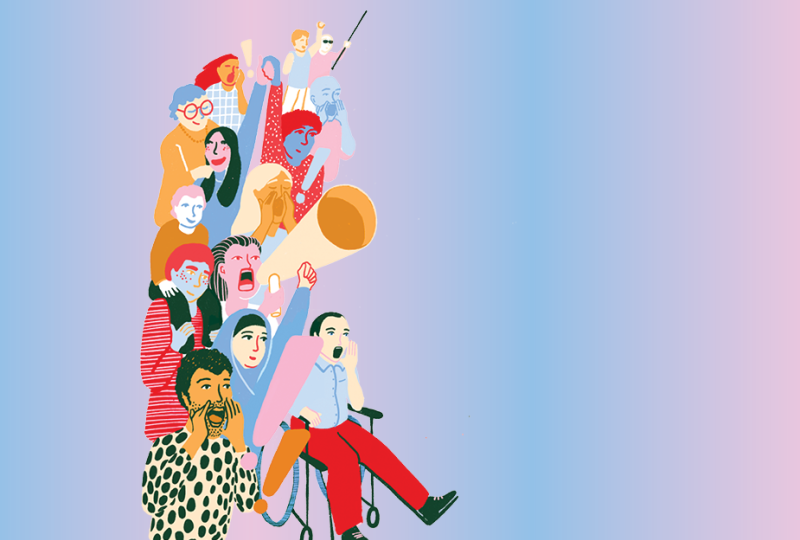


How fortunate we are to be able to call home a country to which people flee, rather than from which they flee. Belgium is said to be a safe haven, but that safety is under attack from politicians who see humanity as a weakness, social rights as a privilege and the rule of law as a mere accessory.
And yet there is so much strength in solidarity.
During Choose Solidarity, we fill the stage with inspiring voices. Voices that think and sing, connect and heal. The poetry of Lisette Ma Neza, the ideas of Houria Bouteldja and the choral songs of Les Invisibles give shape and fire to our struggle for humanity and against colonial border policies that divide people into first- and second-class citizens.
Spreken is Goud by De Roma and Vluchtelingenwerk Vlaanderen invite you to make choices based on solidarity: love over fear, rights over inequality, people over borders.
Lisette Ma Neza is a spoken word artist, as well as a film and theatre maker. From 2024 to March 2026, she was Brussels’ city poet. Lisette will open this event with a live performance of her poetic short film Branden (2024), an ode to displaced women. A collective poem by five different women about the burning of homelands, about the fire and smoke of armed conflicts which transforms humans into refugees.
Houria Bouteldja is an Algerian-French writer and decolonial activist. She is co-founder of the Parti des Indigènes de la République. Her latest book, Rednecks and Barbarians: Uniting the White and Racialized Working Class (2024) is a call to action. How can people who currently refer to one another as ‘them’ ever become ‘us’ together? By standing up against racism and inequality, a better and more just society is possible. Abbie Boutkabout talks with Houria, accompanied by writer and lawyer specialising in migration and refugee law, Anissa Boujdaini.
The choir Les Invisibles brings together sixty women from the Committee of Undocumented Women in Brussels. Caught up in the bureaucratic maelstrom of asylum and migration policy, they receive no administrative recognition in Belgium and therefore no social rights or access to housing, which often puts them at risk of exploitation. With a varied repertoire of protest songs, these resilient women are building bridges with the Belgians and demanding their integration into the Belgian state, with just one solution: regularisation!
This programme is partly in Dutch and partly in English.